
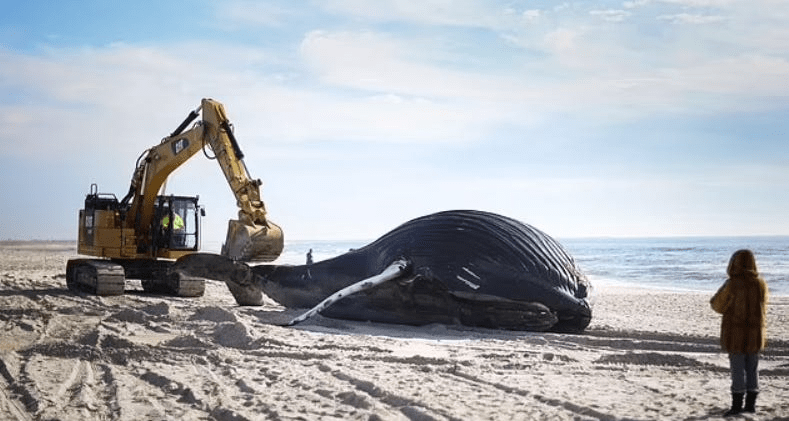
The Biden administration has repeatedly denied the massive wind developments being surveyed and built off the Atlantic coast have had “no impact” on whale and other marine mammal life. Those denials have continued despite the fact that whale deaths in the region have risen from about 2 per year prior to wind development to 28 per year since it began, resulting in great skepticism about the government’s findings.
One professor emeritus at Rutgers University in New Jersey was so curious about the subject that he designed a database application as a research tool to help study it. That man, Apostolos Gerasoulis, a Rutgers professor emeritus of computer science, is one of the co-creators of the search engine that powers Ask.com.
In a story published at the Daily Mail, Grasoulis says wind development off the Northeast Atlantic coast is “absolutely, 100%” the cause of the dramatic rise in the beachings of whales and other marine mammals, many of which are from species on the Endangered Species list.
Here’s an excerpt from that story:
Early in 2023, Gerasoulis began researching whale deaths. That summer he started building a software system to identify any relationship between the dead whales and offshore wind survey vessels, which use loud blasts of sonar to map the seabed for the installation of offshore wind turbines and high-voltage cables.
He named the system Luna.
But the National Oceanic and Atmospheric Administration (NOAA), which is responsible for protecting marine animals and their habitats insists there is no connection.
‘To date, no whale mortality has been attributed to offshore wind activities,’ said Lauren Gaches, NOAA Fisheries public affairs director shortly after Luna’s body was found.
Whale deaths had started increasing several years earlier. NOAA declared ‘unusual mortality events’ for humpback whales in 2016, minke whales in 2017, and North Atlantic right whales also in 2017.
The death count is now up to 534 for these species.
Wind farm developers started sending out sonar vessels to blast the ocean floor with high-intensity sound waves to map it for offshore wind farms in 2016.
But NOAA still denies any connection.
‘At this point, there is no scientific evidence that noise resulting from offshore wind site characterization surveys or pile driving could potentially cause whale deaths,’ Katie Wagner, NOAA public affairs specialist, told DailyMail.com.
‘There are no known links between large whale deaths and ongoing offshore wind activities.’
But according to Gerasoulis, NOAA data reveal that humpback whale deaths in New York, New Jersey and Rhode Island waters went from an average of two per year before 2016 to 20 in the years since.
Last year, 21 humpback whales died in the region.
‘You have 20 dead whales. You used to have two, and now it’s 20,’ Gerasoulis said. ‘So I started looking at this from every perspective.’
He loaded NOAA data on whale deaths, the zigzag courses of survey ships and even wave action into his computer system. Luna revealed patterns that Gerasoulis believes point to offshore wind survey vessels as the cause of the whale deaths.
There’s a lot more in this story, but the point is clear: This real, actual expert says NOAA is at best wrong, and at worst simply lying about the cause of these whale and marine mammal deaths.
That is all.
 Conserve Our AgriCultural Heritage
Leave a comment